

The biggest announcement of Google I/O 2026 on the model side was Gemini 3.5 Flash. The company defines the new model as a model family that “brings frontier intelligence together with action”, and this definition is not just marketing language; Gemini 3.5 Flash was designed with a truly different approach. Running four times faster than competing edge models, outperforming the previous generation Gemini 3.1 Pro in nearly all benchmarks, and running at less than half the cost of comparable models, this model is available today in the Gemini app, Google Search’s AI Mode feature, and the Gemini API for developers.
From Gemini 3 Series to Gemini 3.5: What’s changed?
Launched a few months ago, the Gemini 3 series was Google’s most adopted model family ever; Developers were using Flash in their daily workflows, taking advantage of Pro’s deep reasoning capabilities. While maintaining this foundation, Google focused on two areas in particular with Gemini 3.5: agent-based tasks and long-term workflows.
Google announced that Gemini 3.5 Flash outperforms Gemini 3.1 Pro in almost all benchmarks and shows a dramatic jump, especially in the field of encoding; The benchmark test, called GDPVal, measures tasks that have economic value in the real world, and the jump in this test is quite noticeable. Frankly, the fact that a Flash model surpasses the Pro model of the previous generation is an important sign of how model families evolve.
Everything announced at Google I/O 2026: Gemini 3.5, Smart Glasses and more
Why is speed so important?
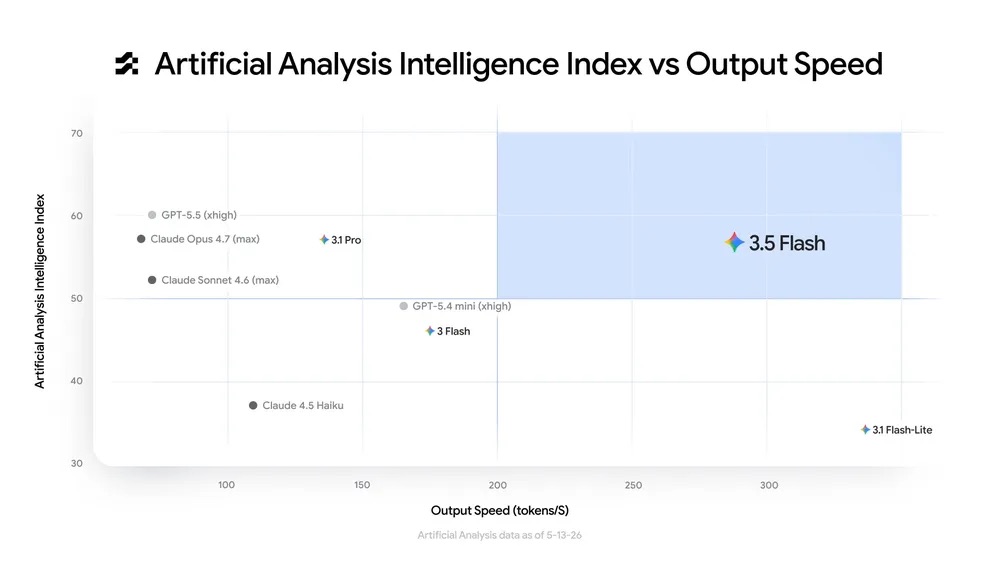
Gemini 3.5 Flash runs four times faster than other edge models, and this speed superiority is especially critical for real-world agent workflows. To make this concrete: When an AI model gives you an answer to a single question, speed may be a secondary consideration. But an agent is constantly working, performing one task after another, using tools and making decisions. A fourfold acceleration of this cycle is equivalent to finishing a job that takes hours in minutes.
By Google’s calculation, large companies processing 1 trillion tokens per day could save over $1 billion annually if they shifted eighty percent of their workflows from other edge models to Gemini 3.5 Flash. This figure is a truly tangible difference for corporate users. Moreover, Google also shared that a special version of Flash that users can access within the Antigravity platform runs not four times, but twelve times faster than other limit models.
Designed for Agent
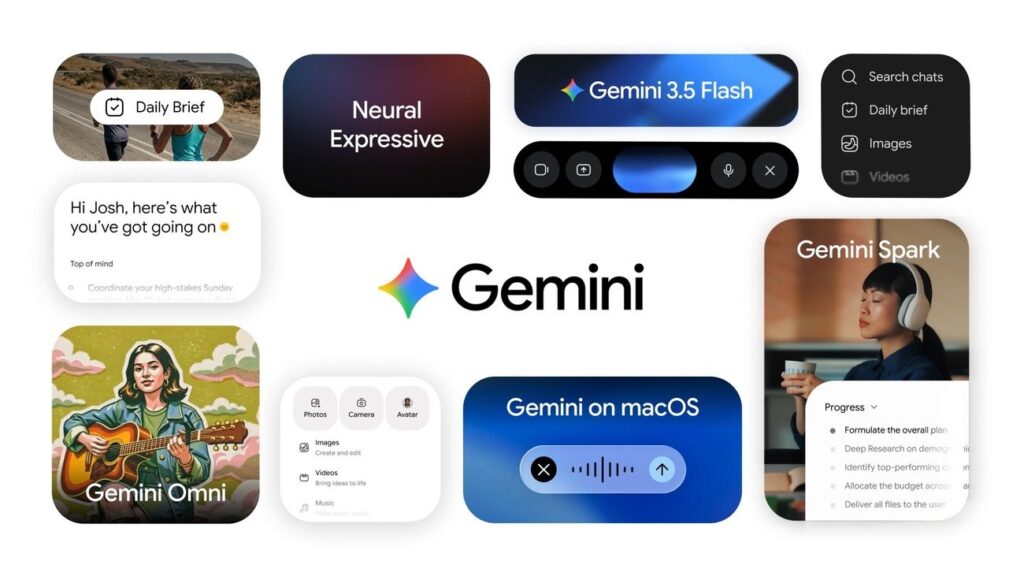
The main difference that distinguishes Gemini 3.5 Flash from previous models is its design philosophy. While previous models were mainly based on generating strong answers to one-off questions, Gemini 3.5 Flash is optimized for executing long-term, multi-step tasks. It can use tools, run code, perform internet searches, and do all of this automatically in the background with the guidance of a human supervisor.
The personal artificial intelligence agent, announced as Gemini Spark, was also built on Gemini 3.5 Flash; This agent works twenty-four hours a day, seven days a week, guiding you in your digital life and undertaking tasks on your behalf. Long story short, Gemini 3.5 Flash is not just a chat model; It was designed to be an artificial intelligence infrastructure that constantly works, takes action and produces results.
The model is also accessible via the Gemini app, Gemini Enterprise Agent Platform, Gemini Enterprise, Google Antigravity, and Gemini API via Google AI Studio and Android Studio. In other words, it is offered simultaneously to consumers, developers and corporate users; When you look at it from this perspective, the scope of the launch is quite wide.
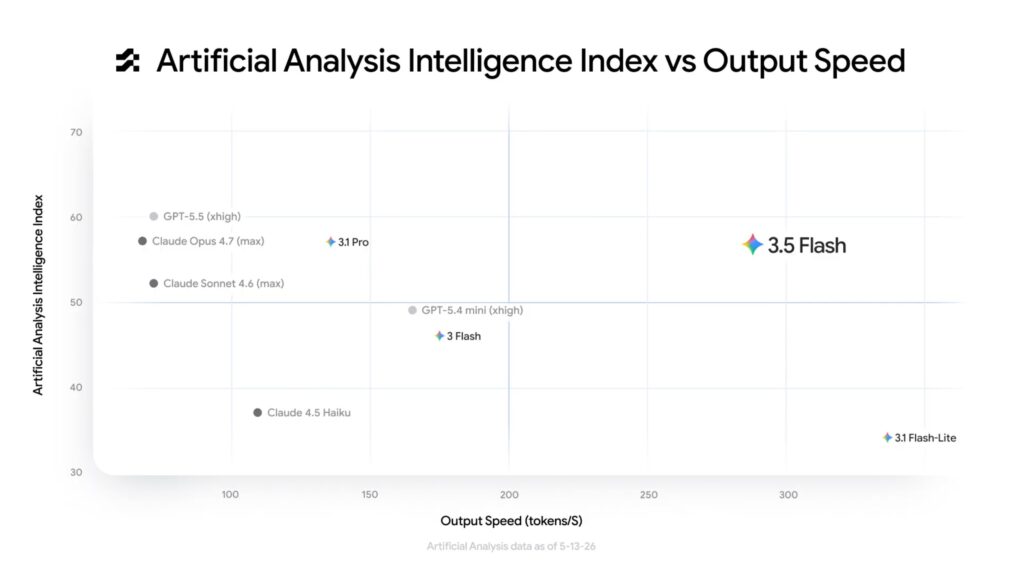
When it comes to benchmarking results, it is always necessary to take a step back and evaluate. The GDPVal test featured by Google is interesting in that it measures tasks that have economic value in the real world; Performance in practical workflows is measured, not just math or language benchmarks. Gemini 3.5 Flash has occupied a remarkable position in the Intelligence Index ranking of the artificial intelligence benchmarking site Artificial Analysis; When looked at on the axis of intelligence level and output speed, it can be seen that the model is positioned alone in the upper right corner, that is, in the category of both strong and fast.
However, benchmark results may not always coincide with the real usage experience. According to Google’s own statements, data scientists and enterprise users tested the model in complex analyzes and got strong results; however, these results need to be confirmed by independent testing. The real-world experiences that developers will share in the coming weeks will give a much clearer picture of how powerful the model really is.
Security and accuracy: New security training
Gemini 3.5 was developed under Google’s Frontier Safety Framework; This new generation model, in which safeguards in the field of cyber security and CBRN (chemical, biological, radiological, nuclear) are strengthened, significantly reduces the problems of producing harmful content and accidentally not answering secure questions compared to previous generations. Google attributes this success to new security training and measures that include interpretability tools that check and understand the model’s internal reasoning process before responding.
This is a significant advance in AI reliability. Particularly for corporate users, problems such as producing insecure content or unnecessarily rejecting legitimate questions posed major practical obstacles; Reducing these problems increases the usability of the model in business environments.
Next Stop: Gemini 3.5 Pro
Google announced that the next model of the 3.5 series, Gemini 3.5 Pro, is currently in use within the company and is planned to be available next month. The Pro model is expected to focus on deeper reasoning and stronger coding capabilities; It is likely to be positioned as an upper tier that complements Flash’s speed and cost superiority.
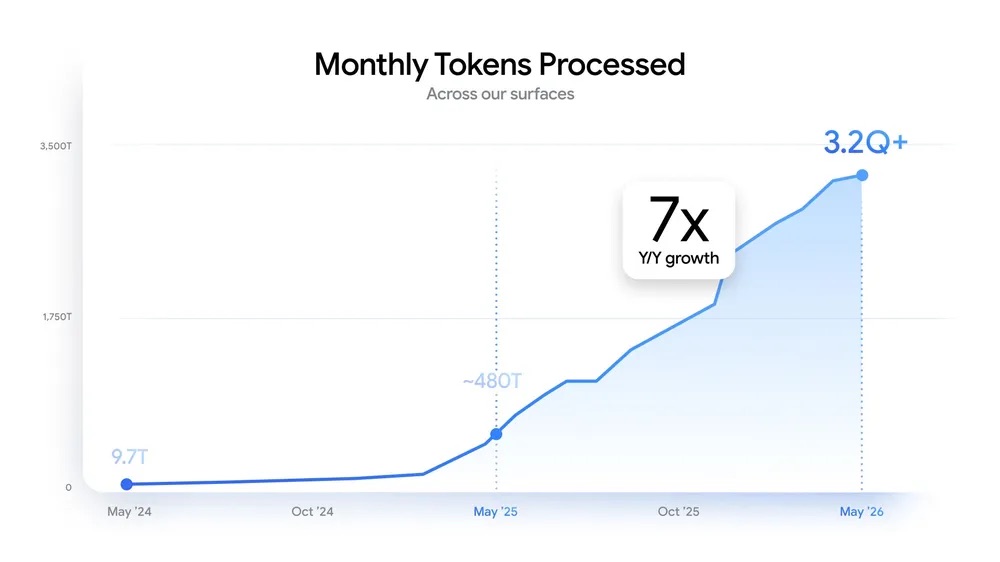
Looking at the big picture, Google’s model strategy becomes clear: to make the Flash series the main model in both the consumer, developer and enterprise segments, and to position the Pro series as the upper tier for tasks that require depth. According to the figures shared by Sundar Pichai in the keynote, Google processes 3.2 quadrillion tokens monthly today; This means seven hundred percent growth compared to last year’s figure of 480 trillion. The role of the Flash model in this growth rate is clearly critical: it would not be possible to sustain this scale without a model that is both fast and cheap.
How can you use Gemini 3.5 Flash?
As of Tuesday, May 19, the model is available to all users via the Gemini application and the AI Mode feature in Google Search; It is also accessible to developers and enterprise users from Google Antigravity, Gemini API (via Google AI Studio and Android Studio) and Gemini Enterprise platforms. On the consumer side, you can access Gemini 3.5 Flash at no additional cost; Developers can start using the model within existing Gemini API quotas.
Make Teknoblog your preferred source on Google Search and see us more often in Top News.

In order not to miss the technology agenda, 📰 add it to Google News, 💬 join our WhatsApp channel, ▶ subscribe to YouTube, 📷 follow us on Instagram and 𝕏 X.