

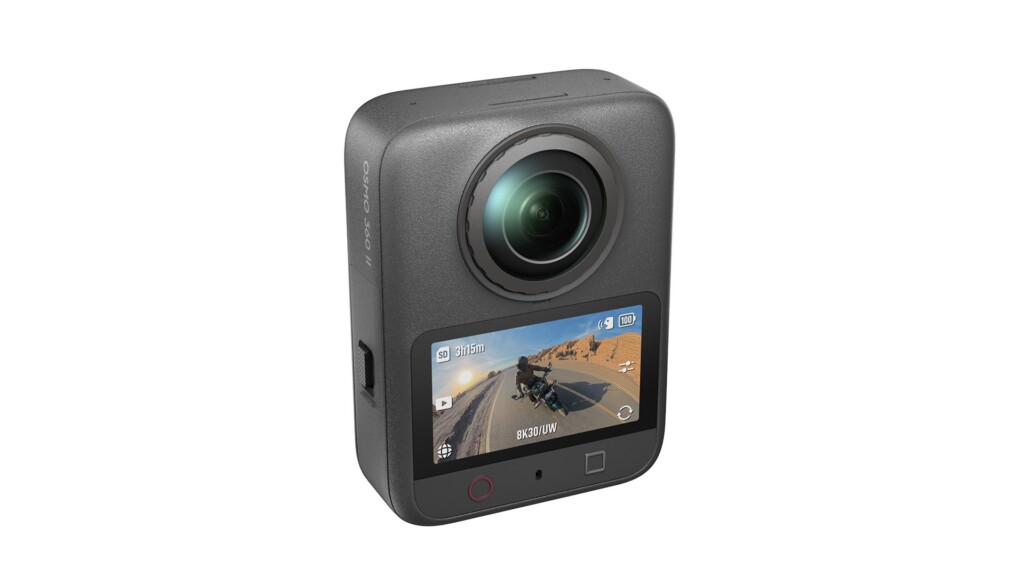
DJI has renewed the Osmo 360 II, the new model of its panoramic action camera series, with more durable and interchangeable lenses, improved low-light performance and higher frame rates. The new camera, which largely retains the basic features of the first Osmo 360, focuses on the problems that users may encounter with the previous model, especially when shooting in harsh conditions. Chief among these are the lenses on both sides of the camera, which are prone to scratches. Switching to a more durable coating on the Osmo 360 II, DJI also allows the lenses to be replaced by the user. The increase in battery capacity, expanded dynamic range and resolution improvements in some video modes are among the prominent changes of the new model.
Due to the structure of cameras that shoot 360 degrees, the lenses protrude from both sides of the body, and this increases the risk of damage, especially in cycling, skiing or similar active sports shooting. DJI is using a new coating on the Osmo 360 II’s lenses that the company describes as “ultra-hard.” The more notable change is that damaged lenses can now be replaced. A pair of replacement lenses will cost 39 euros in Europe and $45 in US pricing. In this way, scratching or damaging the lens can no longer be a costly problem affecting the entire camera.
DJI Osmo 360 II video features improved
At the center of the Osmo 360 II’s imaging system is a 1-inch square sensor, as in the previous model, and the camera can record 360-degree 8K video. DJI seems to have preferred to improve image quality and recording options instead of changing the sensor in this generation. While the dynamic range, which was specified as 13.5 stops in the previous model, is increased to 14.5 stops, the highest frame rate in 8K resolution is increased from 50 fps to 60 fps. On the 4K recording side, it can be up to 120 fps instead of 100 fps. Retaining support for 10-bit D-Log M and HDR recording continues the flexibility of the Osmo 360 II, especially for users who want to perform more extensive color editing on images.
Low light performance is also one of the areas DJI focuses on. The new AI SuperNight 2.0 system aims to achieve cleaner and brighter results in images in dark environments by taking advantage of the artificial intelligence-based noise reduction algorithm. DJI states that the large pixels and fast image processor in the sensor help maintain the sharpness of frames and reduce motion blur. Considering that the previous Osmo 360 was criticized for motion blur in low light, how effective this improvement is in real shooting conditions will be one of the points to be considered for the new model. However, the effect of software-based noise reduction on fine details should also be taken into account when evaluating the camera’s image quality.
Although DJI increased the battery capacity from 1950 mAh to 2150 mAh, the 100-minute usage time announced in 8K 30 fps video recording does not change. On the other hand, there is a small improvement in charging performance and the battery can be brought to 80 percent in 22 minutes. When the optional battery extension bar is used, the total operating time can be increased to 180 minutes. In addition, the time-lapse shooting resolution increases from 8K 30 fps in the previous model to 16K 30 fps. Vortex mode, where 360 degree rotation effects are created, records 8K 120 fps instead of 6K 120 fps, while HDR support is added to 120 megapixel 360 degree photos.
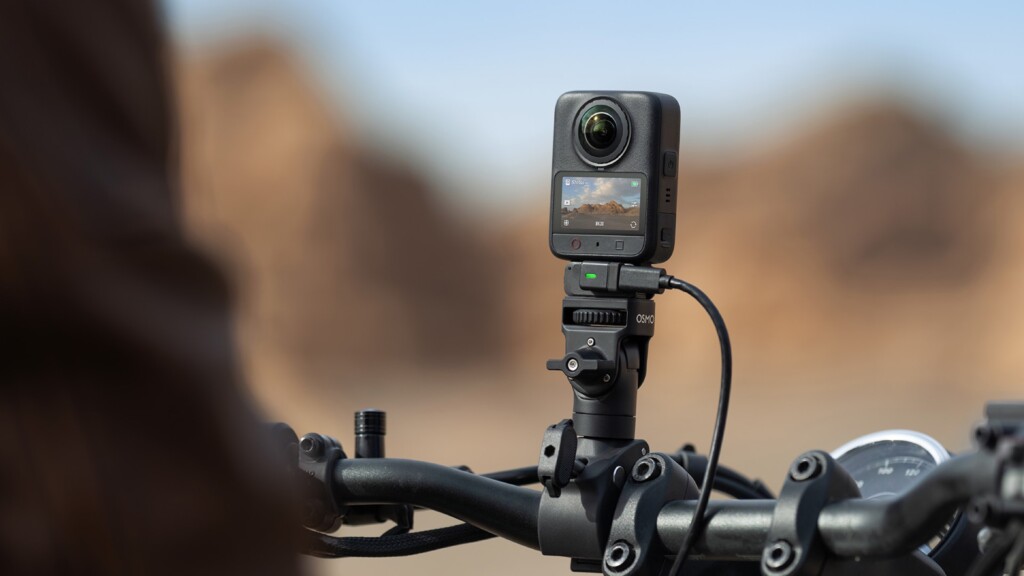
Internal storage remains unchanged, and the Osmo 360 II continues to offer 105GB of usable internal capacity. This amount corresponds to twice the internal storage capacity of the Insta360 X6, which DJI positions as a direct competitor. On the audio side, while the internal system with four microphones and the design to reduce wind noise are maintained, compatibility with wireless microphones such as DJI Mic 3, DJI Mic 2, DJI Mic Mini 2S, DJI Mic Mini 2 and DJI Mic Mini is ensured. Support for DJI and GoPro accessories also offers flexibility for those using different mounting options. In addition, a one-touch connection can be made to the DJI Mimo application via NFC.
The DJI Studio application continues to be used in the post-shooting workflow. In addition, thanks to DJI’s recently introduced DaVinci Resolve plug-in, 360-degree video files can be transferred directly into DaVinci Resolve. This support may reduce the need for a separate conversion or middleware, especially for content creators who use more comprehensive editing and color editing tools on the desktop. Considering that not only the recording features but also the software used to re-frame and edit the image directly affect the user experience in 360-degree cameras, this integration stands out as one of the practical features that complements the changes in hardware.
Osmo 360 II first went on sale in the Asian market and, according to information provided by DJI, will be available in Europe later in September. The UK price of the Standard Combo package was announced as 509 pounds sterling, and the European price was announced as 589 euros. The Adventure Combo, which includes additional batteries as well as a charger and carrying case, is priced at £639 and €739. Despite DJI’s recent positive result in the legal process in the USA, Osmo 360 II will not be available for sale in this country for now. Rather than changing the sensor and basic design approach, the new model focuses on reducing the previous model’s weak points with interchangeable lenses, wider dynamic range, higher frame rates and low-light improvements; In particular, the interchangeable lens structure is the most concrete improvement for those who use the camera in harsh conditions.
Join Channel