

Xiaomi introduced the new members of the Redmi K series, Redmi K100 Pro and Redmi K100 Pro Max, in China. The main differences between the two phones, which are very close to each other in terms of design, appear in the processor, screen size, camera system and battery capacity. While the Redmi K100 Pro uses Qualcomm’s recently announced Snapdragon 8 Elite Gen 5 V Series processor, the K100 Pro Max comes with the standard Snapdragon 8 Elite Gen 5. Both models have up to 16 GB LPDDR5X Ultra RAM option and utilize UFS 4.1 storage technology. In addition, screens with a refresh rate of 185 Hz and high-capacity silicon-carbon batteries are among the prominent common features of the new Redmi models.
The Snapdragon 8 Elite Gen 5 V Series in the Redmi K100 Pro carries the model number SM8850-1-AB and is a differently configured version of the standard Snapdragon 8 Elite Gen 5. The remarkable change between the two processors is seen on the GPU side. While the Adreno 840 GPU in the V Series has two cores running at 1.2 GHz, the graphics unit of the standard Snapdragon 8 Elite Gen 5 has three cores running at 1.3 GHz. Therefore, the K100 Pro Max can be expected to have a higher performance ceiling, especially in terms of long-term gaming loads and graphics performance. The fact that Redmi K100 Pro Max uses the standard Snapdragon 8 Elite Gen 5 is one of the hardware choices that explains the price difference between the two models.
Redmi K100 Pro Max differs on the camera and screen side
Screen features also constitute one of the obvious points of difference between the two phones. Redmi K100 Pro has a 6.56-inch OLED panel that offers a resolution of 2510 x 1156 pixels, and the refresh rate of the screen is up to 185 Hz. Redmi K100 Pro Max, on the other hand, comes with a larger 6.9 inch AMOLED screen with a resolution of 2608 x 1200 pixels and a 185 Hz refresh rate is offered here. Therefore, while the K100 Pro offers more suitable dimensions for those who want a more compact device, the K100 Pro Max appeals to those who prefer a larger viewing area in usage scenarios such as video watching and gaming. The fact that both phones offer a high refresh rate highlights the fluidity of the screen, from interface movements to supported games.
In the camera department, both devices share a 200-megapixel main camera with a 1/1.56-inch sensor, but when it comes to auxiliary cameras, the K100 Pro Max offers a significantly more comprehensive system. The Max model has a 50-megapixel periscope telephoto camera using a Samsung ISOCELL JN5 sensor, and this camera provides 5 times optical zoom. In Redmi K100 Pro, optical zoom remains at 2.5 times. On the ultra-wide-angle camera side, the K100 Pro Max has a 50-megapixel camera with OV50M sensor, while the K100 Pro uses an 8-megapixel ultra-wide-angle camera. These differences make the Max model more flexible, especially for those who shoot from long distances or use the ultra-wide-angle camera frequently.
Xiaomi has also included a feature that goes beyond the usual smartphone layout on the audio side. There is a subwoofer tuned by Bose on the back of both devices. In this way, it is aimed to deliver especially low frequencies more clearly in the internal speaker system of the phones. In addition, Redmi K100 Pro and K100 Pro Max have IP66, IP68 and IP69 protection degrees. These certificates show that the phones are resistant to water contact in different conditions as well as dust. The inclusion of details such as durability and sound system, as well as high-performance hardware, shows that the two models do not differ only in terms of processor and screen features.
Battery capacity stands out as one of the most striking aspects of the Redmi K100 series. While the Redmi K100 Pro has a silicon-carbon battery with a capacity of 8,580 mAh, the battery capacity of the K100 Pro Max increases to 9,070 mAh. Both models offer 100W wired and 50W wireless charging support; In addition, it also has a 27W reverse wired charging feature. Large capacity batteries can provide an advantage in balancing the energy consumption of high refresh rate displays and high-end processors. However, it should be noted that actual usage times will vary depending on factors such as screen brightness, connection conditions and processor load.
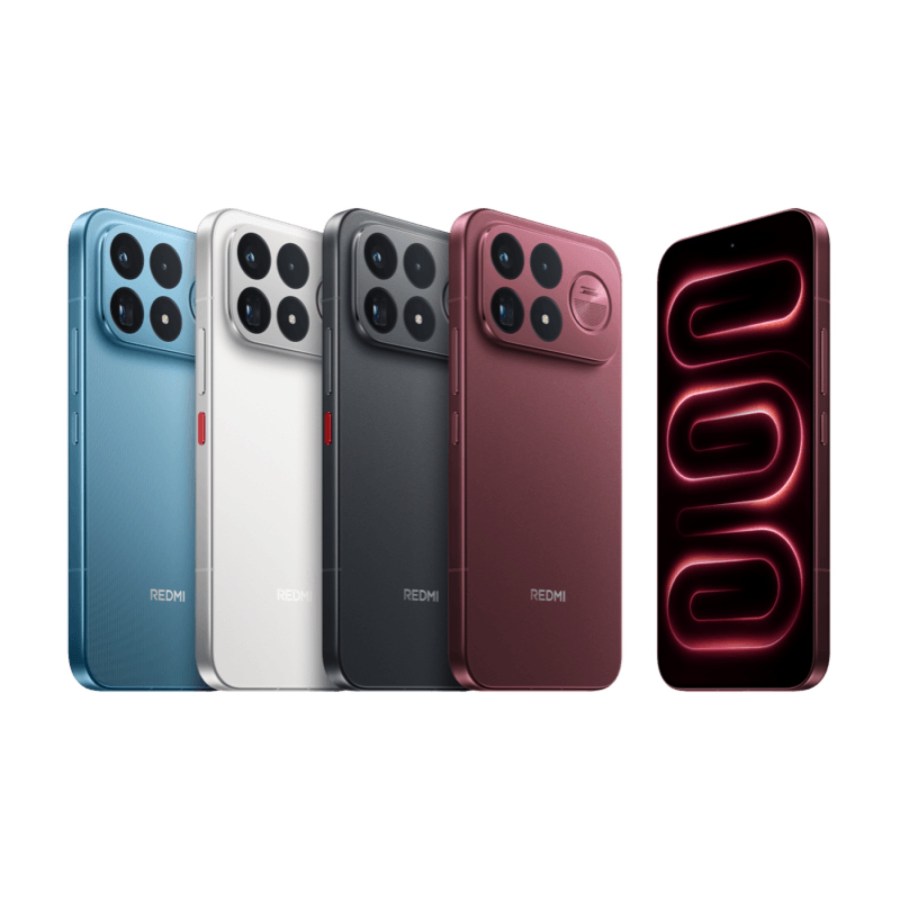
Redmi K100 Pro is offered in purple-toned Volt, white, black and red color options. K100 Pro Max is available in blue, white, black and red colors. In China, the starting version of the Redmi K100 Pro with 12 GB RAM and 256 GB storage carries a price tag of 3,699 yuan. The price of the K100 Pro Max, which has the same memory and storage configuration, is set at 4,199 yuan. The 12 GB + 512 GB option of the K100 Pro is sold for 4,299 yuan, the 16 GB + 256 GB option is sold for 4,099 yuan, and the 16 GB + 512 GB version is sold for 4,699 yuan.
On the K100 Pro Max side, the price of the 12 GB + 512 GB configuration is 4,799 yuan, while the 16 GB + 256 GB model is offered at a price of 4,599 yuan and the 16 GB + 512 GB model is offered at a price of 5,199 yuan. At the top of the series is the 16 GB RAM and 1 TB storage version, offered only for the K100 Pro Max, and the price of this model is 5,999 yuan. Thus, the Max model tries to compensate for the price difference with a larger screen and battery, as well as a more powerful graphics configuration, a periscope camera with 5 times optical zoom and a higher resolution ultra-wide angle camera. While the Standard Pro maintains most of its basic performance features, it has a lower starting price with a smaller screen and more limited auxiliary camera equipment.
Redmi K100 Pro and K100 Pro Max have been announced for the Chinese market for now. The fact that Redmi K90 Pro and K90 Pro Max were offered in the international market last year as Poco F8 Pro and Poco F8 Ultra, respectively, raises the possibility of a similar naming. If the same approach continues, it is possible that the K100 Pro and K100 Pro Max will leave China in the future under the names Poco F9 Pro and Poco F9 Ultra. However, since there is no official announcement made by Xiaomi in this direction, it is too early to make a definitive assessment about global model names and sales schedule. Considering the available features, the K100 Pro stands out with its more balanced size and price, while the K100 Pro Max is positioned as an option for users who want more in camera, graphics performance and battery capacity.
Join Channel